
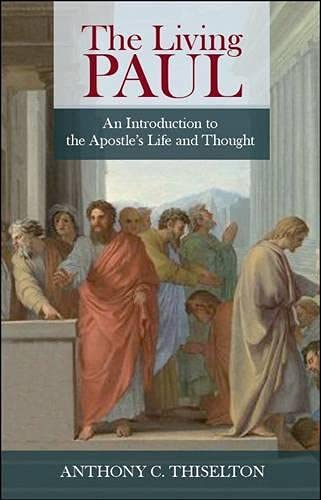
In The Living Paul, theologian Anthony Thiselton provides an excellent overview of Paul’s life and theology in a concise volume that will be of interest both to those beginning Pauline studies, as well as to those more familiar with Paul’s theology. In writing the book, Thiselton’s stated aim is to provide an introductory work to Paul which is accessible whilst avoiding “undue oversimplification” (pvii). His desire is to “concentrate on Paul’s theology, as well as including other aspects of his life and practice” whilst aiming at “succinctness and conciseness” (pvii). Whilst Thiselton’s scholarly work is primarily in the field of hermeneutics, his expertise extends beyond this as he has also written a commentary on First Corinthians. He is therefore in a good position to write a brief work on the life and theology of Paul.
Thiselton’s work outlines Paul’s life and theology over the course of seventeen chapters. The first four chapters provide vital context to those approaching Pauline studies for the first time, and include ‘obstacles’ to the study of Paul, as well as a brief overview of Paul’s life as a pastor, missionary, traveller, and letter-writer. Chapters five to seventeen go into more detail covering various topics in Paul’s theology.
The Living Paul has a number of strengths. Firstly, it is well researched, and the index of authors demonstrates Thiselton’s erudite scholarship, with over 180 authors cited (p182). The author’s organisation of his material is excellent, and there are helpful subheadings which are particularly useful for students new to Pauline theology. He is skilful in summarising key scholars’ views in an accessible, yet thorough, way (c.f. Thiselton’s treatment of Robinson’s view on the body of Christ, p103). Indeed, it is quite an achievement to survey both the life and theology of Paul in one work, particularly one of only 162 pages. Moreover, he concisely demonstrates how different scholars’ works relate to, and engage with, one another.
Secondly, Thiselton helps the reader to understand Paul’s writings within their wider historical context. For example, he consistently shows awareness of the implications of Paul’s theology for the early Church (c.f. the analysis of Paul’s theology in the context of the question concerning Christ’s divinity raised by the fourth century Church Fathers, Athanasius and Basil of Caesarea, p46). The prose is also engaging and accessible. For example, the author writes “The body and the world form the theatre of redemption on display” (p126), a statement which succinctly captures the importance of Christian ethics for Paul.
Thirdly, The Living Paul compares favourably to other similar works in the field such as Paul: A Beginner’s Guide (Hooker, 2012), Paul: A Very Short Introduction (Sanders, 2001), and An Introduction to the Study of Paul (Horrell, 2015). It is true that in some areas, Thiselton’s analysis of Paul lacks depth. For example, Sanders arguably engages more with the theme of “Righteousness by faith and being in Christ”, devoting two entire chapters to it. However, Sanders does not deal with the topic of Paul and women, nor with Paul’s view of Baptism and the Lord’s Supper, to the same extent as Thiselton. As such, The Living Paul covers a broader range of topics within Pauline theology when compared to other similar introductory works. Indeed, one of Thiselton’s distinctive contributions to Pauline studies in this volume, at least at the introductory level, is his chapter on Paul and Postmodernity. The aforementioned works of Hooker, Horrell, and Sanders provide no such analysis of Paul’s relationship with this major philosophical movement of the late twentieth and early twenty-first centuries, whereas this is one of the major strengths of The Living Paul.
However, there are two weaknesses in Thiselton’s book. Whilst it is to be commended for its conciseness, the book is at times hindered by its brevity. For example, in attempting to cover Paul’s doctrine of “Justification and the Law” in only nine pages, the author leaves little space to provide even the beginning of an exploration of the complex debate concerning the ‘New Perspective(s)’ on Paul. A further weakness is that Thiselton, on occasion, develops an argument without providing sufficient consideration of opposing perspectives. This can be seen clearly in his treatment of Paul’s view of women and Christian ministry. On this issue, his analysis and argumentation is not as strong, primarily because he does not engage with opposing views substantially, even when we concede that this book is merely an introductory guide to Paul’s thought. For example, he states that “Junia…was a woman apostle” (p114), without highlighting the considerable amount of scholarly debate on this particular claim. It is not clear whether Thiselton addresses this issue with insufficient detail due to a lack of available space, or because it is convenient for his argument, but it remains a deficiency.
Overall, Thiselton has achieved his aim of writing an introductory work to Paul which is both accessible whilst avoiding undue oversimplification (pvii). Undergraduate students who wish to read a short introduction to Paul’s life and thought will find this to be a very helpful guide, as will the informed ‘layperson’ who wishes to engage with Paul’s theology more deeply. However, even postgraduate students who desire a short yet richly informative introduction to Paul’s theology and, to a lesser extent, his historical context, will benefit from reading this book.



 Theology For Life
Leave a comment