
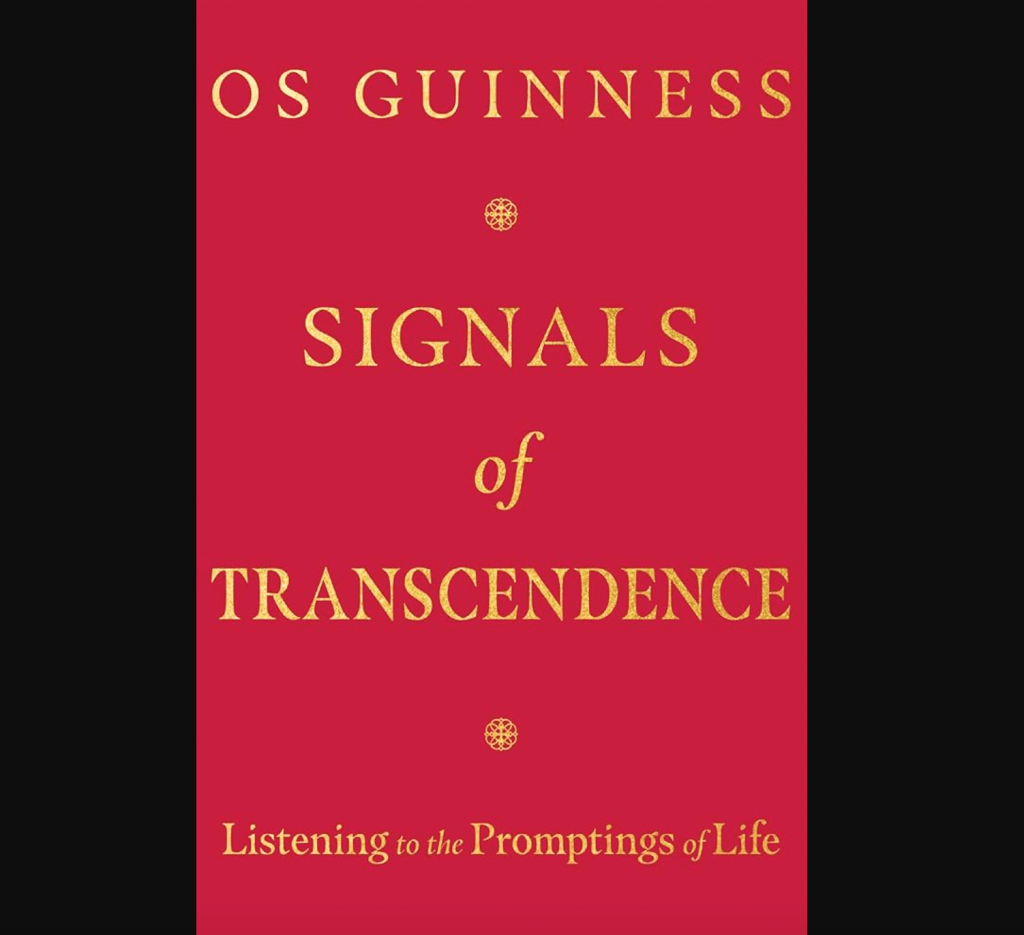
A growing number of non-Christians I meet seem increasingly willing to explore spiritual questions in ways that would have surprised me a decade ago. They often believe that there’s “something more” to our existence, even if they can’t articulate what that might be. This reflects a broader cultural shift, as those identifying as “spiritual but not religious” have increased dramatically over the past quarter of a century [1]. It is in this context that Os Guinness’ latest book, Signals of Transcendence, proves to be a particularly valuable resource for those sharing the good news of the Lord Jesus with seekers and sceptics.
Guinness defines signals of transcendence as those “arresting and intriguing experiences that both capture our attention and call for further explanation.”[2] It may include the appreciation of God’s goodness and beauty in music or art, a sudden epiphany, or even a near-death experience. Through ten carefully selected case studies – including Malcolm Muggeridge, Leo Tolstoy, and C.S. Lewis – Guinness tells the stories of famous individuals who encountered such signals. What emerges is a fascinating portrait of the search for ‘something more.’ Some embrace these signals of transcendence as life-defining revelations, while others retreat back into comfortable scepticism or wilful ignorance. The author’s honesty about this mixed reception is refreshing: he acknowledges that receiving a signal is one thing, but heeding its call requires surrendering everything to God, which many find too demanding.
There is a risk that a book on signals of transcendence could implicitly endorse a form of mysticism, prioritising subjective spiritual experiences over God’s revealed truth. However, Guinness carefully avoids this danger. Throughout the book, he demonstrates that these signals are not ends in themselves, but a gracious means through which God draws people towards His revealed truth in Scripture. One particular highlight was the chapter on C.S. Lewis’ experience of joy. Whilst Lewis’ journey from hardened atheist to Christian will be well-known to many readers, it is Guinness’ description of how Lewis was converted that is deeply insightful. It was largely Lewis’ experience of other-worldly joys – found in music, poetry, nature, and literature – which prompted his search and ultimately led him to trust in the God of the Bible. He would later describe these signals in his famous statement: “If we find ourselves with a desire that nothing in this world can satisfy, the most probable explanation is that we were made for another world.”[3]
In a culture which is increasingly open to the possibility of the supernatural, Signals of Transcendence is an incredibly helpful resource. It would be an ideal book to share with a friend who is sceptical about Christianity and yet is searching for something beyond a merely materialistic worldview. Guinness is a superb storyteller, and he makes the book accessible by ensuring any treatments of philosophical topics are free from academic jargon. It would also be beneficial for Christians seeking to understand how an appreciation for God’s truth, goodness, and beauty in the world can provide opportunities for evangelism.
References
[1] David Kinnaman, “Meet the ‘Spiritual but not Religious”, 6 April 2017, barna.com
[2] Os Guinness. Signals of Transcendence. IVP, 2023.
[3] C.S. Lewis, Mere Christianity. Collins, 2012.




 Theology For Life
Leave a comment